
Cecil Sydney Adams, maternal relative
Cecil Sydney Adams, was born in Spalding, Lincolnshire, England in October 1894 and was Killed in Action during the Battle of Loos on the 13th of October 1915.
Cecil Sydney was related to me on the Priday/Sheward side of my family. The actual lineage is as follows:
- Cecil Sydney Adams 1894-1915 - paternal 1st cousin of husband of 3rd cousin 1x removed>
- Henry Adams 1852-1926 - Father of Cecil Sydney Adams
- William Pitt Adams 1818-1885 - Father of Henry Adam
- >Joseph Edward Adams I 1855-1911 - Son of William Pitt Adams
- William Henry Adams 1877-1960 - Son of Joseph Edward Adams I
- Edith Sheward 1878-1974 - Wife of William Henry Adams
- Edward Sheward 1854-1927 - Father of Edith Sheward
- Emma Davis 1837-1912 - Mother of Edward Sheward
- Thomas Sheward 1812-1883 - Father of Emma Davis
- Edward Sheward 1775-1853 - Father of Thomas Sheward
- Richard Sheward 1817-1870 - Son of Edward Sheward
- Herbert Sheward 1843-1906 - Son of Richard Sheward
- Mary Louisa Sheward 1880-1967 - Daughter of Herbert Sheward
- Alice May Priday 1917-2009 - Daughter of Mary Louisa Sheward
- William G Hyde - Me
His Family
Cecil Sydney Adams father, Henry Adams was born in October 1852 at The Cottage at Court House, Clifton-upon-Teme, Worcestershire, England. Henry was trained as a Carpenter, probably by his father Willaim Pitt Adams, who was a Stone Mason & for a few short years also the owner of the George Hotel in Little Dean, Gloucestershire.
Henry Adams married Mary Ann Oldham in 1873 in Grantham, Lincolnshire. Mary Ann was 14 and Henry 21.
Henry & Mary Ann set up home at 45 Duke St, Boston, Lincolnshire and set about raising a family, which enventually extended to 9 children:
- Sarah Ann Adams (1875-1950)
- Frederick William Adams (1878–1945)
- Edith Annie Adams (1879–1882)
- Arthur Henry (Harry) Adams (1881–1940)
- Lizzie (Elsie) Adams (1883–1952)
- Charles Percy Adams (1884–1921)
- Ethel May Adams (1887–1980)
- Cecil Sydney Adams (1894–1915)
- Stanley James Adams (1897–1944)
The family moved from Boston to 94 Hawthorn Bank, Spalding, Lincolnshire and Henry joined the Great Northern Railway and became a Railway Signalling Fitter.
Henry Adams died on the 31st of March 1926 at 94 Hawthorn Bank, Spalding and Mary Ann died in Spalding in October 1951.
Cecil Sydney Adams was born at 48 Hawthorn Bank, Spalding and by 1911 he & his family had moved to 94 Hawthorn Bank, Spalding. Cecil Sydney had started work for the General Post Office (GPO) as a Telegram Messenger. He soon progressed in the GPO and by May 1913 he had become a Postman in Burton-on-Trent, Staffordshire. From there he was moved to Postal duties Luton, Bedfordshire. Cecil Sydney Adams never married.
His Military
Cecil Sydney Adams enlisted in 1914, when the general call to arms was issued after the declaration of war. He became Private C.S. Adams, 1/4th Battalion (Territorial Force), Lincolnshire Regiment, Regimental No. 2563.
The 1/4th Battalion (Territorial Force), Lincolnshire Regiment was formed in Lincoln in August 1914 and became part of the Lincoln & Leicester Brigade, North Midland Division.
The Lincolnshire Regiment rapidly moved to Luton, Bedfordshire to train for overseas operation (and that is why Cecil was allocated to the regiment when he enlisted in Luton.
The Division landed in Le Harve, France on 1st March 1915 and was the first complete Territorial division to arrive on the Western Front to reinforce the British Expeditionary Force (BEF).
On 12 May 1915,the formation was retitled as 138th (1/1st Lincoln and Leicester) Brigade, 46th (North Midland) Division.
The Battle of Loos
The Battle of Loos took place on the Western Front between 25 September and 13 October 1915. At the time, it was the largest British offensive of the First World War and witnessed the Army's first use of gas.
The attacks too place in an area of coalmines and mining villages near the town of Lens, north of Arras. Six British divisions attacked strong German defences in support of French offensives to the south.
The attackers suffered very high casualties in capturing the village of Loos, Hill 70 and the formidable Hohenzollern Redoubt, including some self-inflicted losses from the use of chlorine gas against the Germans. Worse came as British units tried to repel German counter-attacks. Despite initial successes and hopes of a breakthrough, the British lost the ground they had gained. By the time the battle ended British losses in men killed, wounded or missing amounted to over 60,000.
And one of those 60,000 was Cecil Sydney Adams, Killed in Action of the last day of the battle.
His Burial
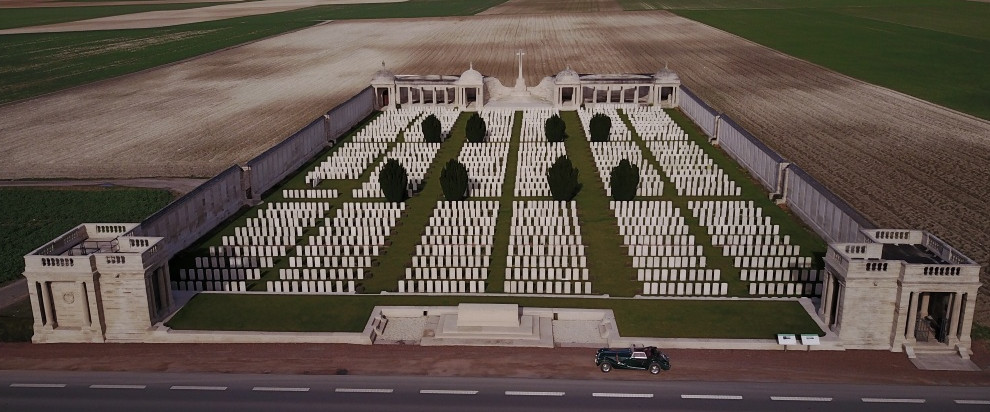 Cecil Sydney Adams is commemorated on the Loos Memorial, Panel 31 to 34.
The Loos Memorial commemorates over 20,000 officers and men who have no known grave, who fell in the area from the River Lys to the old southern boundary of the First Army, east and west of Grenay, from the first day of the Battle of Loos to the end of the war. On either side of the cemetery is a wall 15 feet high, to which are fixed tablets on which are carved the names of those commemorated. At the back are four small circular courts, open to the sky, in which the lines of tablets are continued, and between these courts are three semicircular walls or apses, two of which carry tablets, while on the centre apse is erected the Cross of Sacrifice.
The memorial was designed by Sir Herbert Baker with sculpture by Charles Wheeler. It was unveiled by Sir Nevil Macready on 4 August 1930.