
The former Benedictine Priory of St James, Bristol
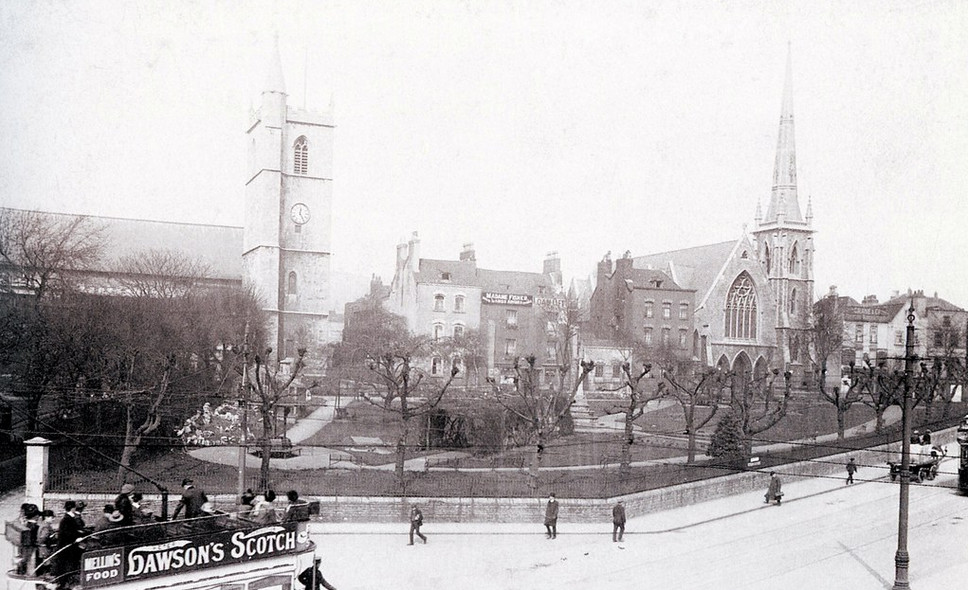 The former Benedictine Priory of St James is the oldest building in Bristol!
It has a fascinating story to tell and has witnessed almost a millennia of Bristol’s development.
St James' church was originally built for a small priory of Benedictine monks, founded in the 1120s by Earl Robert of Gloucester. Tradition has it that when the Bristol castle was being built, every tenth stone brought from Normandy was given for the construction of this church. Late Norman features can still be seen in the western section.
In 1374 St James became the church of a new parish. To house the parish bells, a simple early Perpendicular tower was added on. In common with many other Bristol churches, it has the idiosyncrasy of one pinnacle rising higher than the other three. The nave was also given a new timber roof, resting on carved stone corbels.
In the second half of the 19th-century, it was found necessary to enlarge the interior as St James was a highly populated parish. Despite prophecies that the whole church would tumble down if anything was disturbed, the north aisle was successfully rebuilt, though not as large as had been hoped because of lack of money. During these renovations, it was discovered that the old flying buttresses were composed of portions of 16th-century tombstones.
The church was first lit by gas in 1818, the local newspaper noting that the elegance of the brasswork added to the judicial arrangement of the beautiful lights.
Major development and conservation work was carried out between 2009 and 2011. St James Priory is a charity that provides residential treatment and support for people with addictions. Sunday Mass is held weekly.
The week-long St James' Fair was held annually in the churchyard from medieval times. As confusion arose as to the exact date, in 1738 it was fixed at September 1st. A great deal of business and trading was carried on and the streets around were filled with stalls and booths. There were amusements as well, and the church elders gradually decided that such goings-on were not suitable.
The 1837 fair was, therefore, the last one, attended by 30 merchants as well as circuses, actors and peep-shows.
Towards the end of the 19th-century, the churchyard was used occasionally as a fairground and later as a public park. Eventually, it was covered by a large department store. The base of the old churchyard cross remains.