
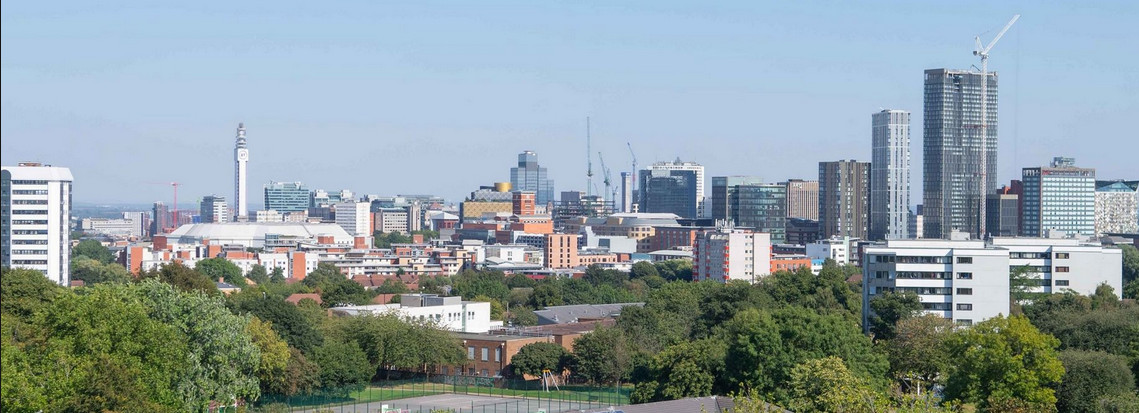
 Modern Birmingham skyline (part) 2022
Birmingham: My Home City
History:
7th Century
My city was born out of a place that has officially existed as a place since the 600s, Birmingham was an Anglo-Saxon farming hamlet on the banks of the River Rea.
11th Century
By the time the Normans came round collecting their tax by recording places in the Domesday Book in 1086, Birmingham was listed as being a small village, worth only 20 shillings annually (to the new Norman invader/landlords).
12th Century
In 1166 the holder of the manor of Birmingham, Peter de Birmingham, was granted a Royal Charter to hold a market and so the village changed from a farming community into a centre for commerce - and that is basically what it still is today. From those humble beginnings, the Horse Fair, Bull Ring Fair and Goose Fair were developed. Sadly the Goose Fair is long gone, but the other two fairs are recorded in Birmingham districts.
16th Century
During the period 1501 - 1600 Birmingham became a centre for industry. The easy access to iron ore and coal meant that metalworking had started. Birmingham soon became a well-known place where cutlers made knives, nailers made nails and many blacksmiths worked at their forges. In addition, wool was still woven and dyed & leather was tanned and made into goods in the town.
17th Century
By the time of the English Civil War (1642–1651), Birmingham had become an important manufacturing town with a reputation for producing small arms (guns) and swords & daggers.
18th Century
The major change came with the Industrial Revolution in the 1700s as Birmingham turned itself into a major industrial centre and the town prospered. Birmingham’s population grew from 15,000 in the late 17th century to 70,000 a century later. This was the time of invention & creation. Artefacts made in Birmingham included buckles for shoes, blades, pins, nails, screws, bolts and buttons. Some craftsmen made brass fittings such as handles for coffins. There were also many gunsmiths and some locksmiths. In the late 18th century glass making boomed in Birmingham.
Such luminaries as James Watt (steam engines), Matthew Boulton (steam engines), Joseph Priestley (philosopher & political theorist), John Baskerville (typeface & printing), James Brindley (engineer & canal builder), Benjamin Franklin (author, printer & American founding father), Samuel Galton (gunmaker), William Murdoch (gaslighting) all lived in or had their business based in Birmingham. In this century, Lloyds Bank was founded in Birmingham, using money from its ironworking founding family.
19th Century
By the start of the 1800s, the Industrial Revolution was in full swing and Birmingham was becoming known as the centre of a 1001-trades - meaning that if it could be made, it was probably being made in Birmingham. The tradesmen of the town still made nails, brass goods (such as bedsteads, shell & bullet cases), nuts and bolts, screws and buttons. They also made pen nibs and toys. There were also jewellers and gunsmiths in Birmingham. In the late 19th century railway carriages were made in Birmingham. So were bicycles. Glass making was also an important industry. From the end of the 19th century, there was also a cocoa and chocolate industry at Bourneville. In 1889 Birmingham is made a city.
20th Century
Birmingham University was founded in 1909. Birmingham Repertory Theatre was built in 1913. On the industrial front, the traditional metalworking industries continued so did more modern ones like bicycle making and tyre manufacture. Electrical engineering became an important industry at that time.
The South African War (Boer War 1899-1902) Memorial in Cannon Hill Park was built in 1905. A Hall of Memory (commemorating our dead from World War 1) was built in 1925. Fox Hollies Park opened in 1929. The Barber Institute of Fine Arts opened in 1932. A School of Speech and Drama opened in 1936. Queen Elizabeth Hospital was opened in 1938.
During World War II Birmingham was, as a major manufacturing centre, an obvious target for German bombing. More than 2,000 people died as a result of the bombing. Factories made (amongst other things) arms, ammunition, planes (Spitfires), motor vehicles, bicycles, tyres, food products, and the traditional domestic wares.
21st Century
Most of the heavy engineering has been long gone although some specialist firms still exist. The manufacture of enamelled decorative items, buckles & buttons still clings on, as does jewellery design & manufacture. But most of Birmingham's wealth now comes from the Service, Finance & Tourism sectors.
Commonweath Games
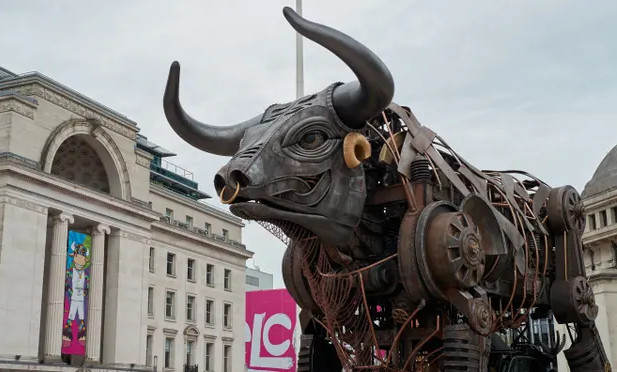 In 2022, Birmingham became the home of the Commonwealth Games from the spectactular opening ceremony on 28th July (featuring Raging Bull, a 10-metre high, mobile puppet) until Monday 8th August, when the curtain came down on a very successful sporting occassion with Birmingham home grown sons, Tony Iommi & Ozzy Osbourne belting out one of the best known Black Sabbath heavy metal "standards" with a scratch built (for one night only) rhthym section.
Birmingham 2022 boasted the biggest sporting and para-sport programme and more medals for women than men for first time ever at major multi-sport event. And it was delivered on time and on budget!
We had just 4 and half years, not the usual 7 years to create & deliver the games.
Birmingham hosted 6,500 athletes and officials from 72 Commonwealth nations and territories.
In total, 1.5 million tickets were sold and most events were sell outs!
By all accounts, Birmaingham 2022 was an unrivalled success - and could become the model for my city to bid for other great sporting & cultural events (lets hope so)!