Barrow Stores: Birmingham's Fortnum & Mason
From 1849 until December 1973 there was a Barrow’s store on Bull Street, just around the corner from Lewis's.
Richard Tapper Cadbury was born in 1768, in Exeter; he arrived in Birmingham in 1794 with his friend Joseph Rutter and opened a drapers shop at 92, Bull Street. His son, John born in 1801, took an apprenticeship with a tea company in Leeds, and upon his return to Birmingham in 1824 he borrowed money from his father to start a business. He opened a shop on the 4th March 1824 at 93 Bull Street, next door to his parents, selling tea, coffee and cocoa and established the business as Barrows Stores Ltd.
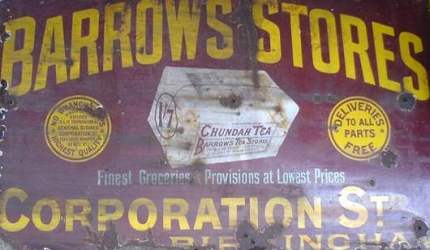
Old enamelled sign (on a sheet of tin, probably made in Birmingham)
In 1849 Richard Cadbury Barrow took over the tea and coffee warehouse in Bull Street from John Cadbury. Richard Cadbury lived initially at Moseley Hall and then at Uffculme House, built for him on the plot next door to Joseph Chamberlain's Highbury Hall.
Corporation Street did not exist, it was built during the redevelopment of central Birmingham as part of the Improvement Scheme of the 1870s, breaking through Bull Street midway and taking away the dwelling place and rear garden of the Barrow Stores building. From then on Barrows was on the corner of Corporation Street and Bull Street, opposite where the Rackham's store was later established.
The old Bull Street premises had been demolished in 1904, and a new shop was built (on the same site). The new premises incorporated a ‘restaurant’ that was opened on the first floor of the store in 1905, partly so that customers could sample the tea and coffee sold by Barrows. It sounds tempting to the weary shopper: "The Cafe has large windows overlooking Corporation Street, from which a peep of the busy throng below can be obtained. It is elegantly and tastefully furnished, is panelled with fumed oak, and lit by electricity". More cafes were added through the years, catering for different customers. Barrow’s Christmas List for 1930 shows six ‘Café & Luncheon Rooms’: General, Seasonal, Adam, Picture, Smoking and Tudor.
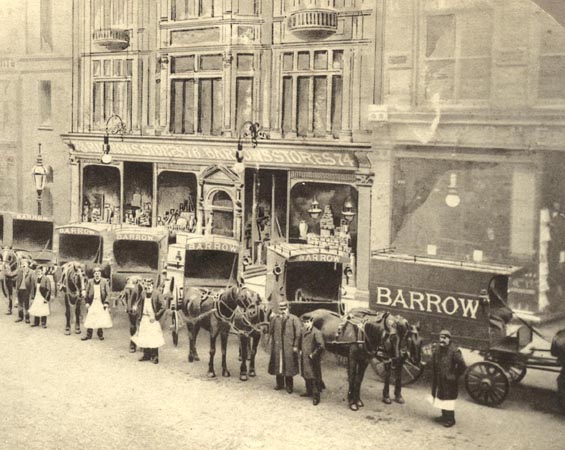
Adjacent to the "Stores", accessed by Dalton Street was the warehouse that included the covered garage where the delivery vans were stored and loaded because Barrows offered a delivery service covering the whole of the Birmingham area and the surrounding areas including Wolverhampton, Lichfield & Barnt Green. Before WW1, these delivery vehicles were all horse-drawn vans and it is probable that the Dalton St premises included stables.
During the early 1960s, the original Bull Street premises were demolished and Barrows Stores moved to a smaller unit lower down Bull Street, opposite Lewis's.
In the mid-1950s, Barrows Stores had a kiosk on the main platform at New Street Station where they sold a small selection of their goods, (mainly fruits) to passengers.
Care for the staff
The store-owners were also concerned for the well-being of their staff as well as their profits. Like the Cadburys (chocolate makers) to whom they were related, they were Quakers. Facilities provided for the staff included a comfortable dining room, a billiard room and 'the nucleus of a library.'
A new employee, called 'an assistant' was not let loose on a customer until he/she had progressed through all the departments in the warehouse and therefore knew the products being sold. Some of the staff even went to evening classes to become certified grocers. One such new employee in 1901 was Ephraim William Hyde, my paternal Grandfather.
Expansion & Demise
Barrows Stores acquired the business of C.C. Barrows which had shops at Five Ways and in Harborne High Street in the late 1950s. Eventually, Barrows Stores Ltd was sold, in 1966, to Fitch Lovell, then a larger supermarket chain. Fitch Lovell themselves were sold to Booker in 1990 for £300million.
Booker's has developed into Booker Group plc and is the UK's largest Cash & Carry and delivery wholesale food supplier serving some 338,000 catering businesses (including pubs and restaurants) and nearly 73,000 independent retailers through its 170-plus cash-and-carry branches. It distributes about 18,000 products, including fresh and frozen food, tobacco, wines and spirits, and general merchandise, to foodservice operators and caterers, independent grocers, and convenience retailers.
In 2018, Tesco (a major British supermarket) bought all of the Booker Group plc and turned it into a private limited company and subsidiary.