
British & Canadian WW1 battlefield casualty handling
Once a British (or Candian) soldier was injured, by gunshot, bombing or shelling both the British & Canadian Armies moved their injured as quickly as possible, to either treat them & return them to active duty as soon as was practical; to treat them before evacuation to England or, sadly, to bury them.
The following details the various steps along these journies.
Frontline Treatment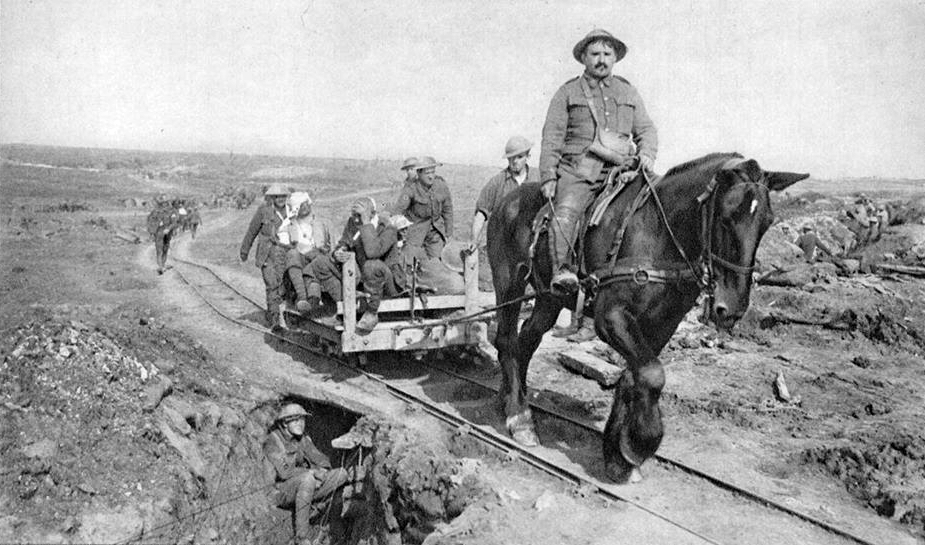 Initially, the injured received first medical attention at aid posts situated in or close behind the front line position. Units in the trenches provided such posts and generally had a Medical Officer, orderlies and men trained as stretcher-bearers who would provide this support. When possible, the stretcher-bearers & Medical Officer's would recover wounded from outside of the trenches as well as deal with those that were injured whilst in the trenches.
Bearer Posts
The Field Ambulance would provide relays of stretcher-bearers and men skilled in first aid, at a series of "bearer posts" along the route of evacuation from the trenches. All involved were well within the zone where they could be under fire.
The Field Ambulance & Dressing Stations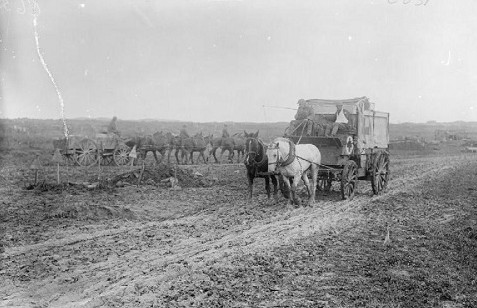 The Field Ambulance was a mobile medical unit, not a vehicle. Each British division had three such units, as well as a specialist medical sanitary unit. The Field Ambulances provided the bearer posts but also established Main and Advanced (that is, forward) Dressing Stations where a casualty could receive further treatment and be got into a condition where he could be evacuated to a Casualty Clearing Station. Men who were ill or injured would also be sent to the Dressing Stations and in many cases returned to their unit after first aid or some primary care.
There was no hard and fast rule regarding the location of a Dressing Station: existing buildings and underground dugouts and bunkers were most common, simply because they afforded some protection from enemy shell fire and aerial attack. The Dressing Stations were generally manned by the Field Ambulances of the Royal Army Medical Corps.
Once treated at a Dressing Station, casualties would be moved rearward several miles to the Casualty Clearing Station. This might be on foot, on a horse-drawn wagon, motor ambulance or lorry or in some cases by light railway (right).
Casualty Clearing Station
The CCS was the first large, well-equipped and static medical facility that the wounded man would visit. Its role was to retain all serious cases that were unfit for further travel; to treat and return slight cases to their unit, and evacuate all others to Base Hospitals. It was often a tented camp, although when possible the accommodation would be in huts.
CCS's were often grouped into clusters of two or three in a small area, usually a few miles behind the lines and on a railway line. A typical CCS could hold 1,000 casualties at any time, and each would admit 15-300 cases, in rotation. At peak times of battle, even the CCS's were overflowing. Serious operations such as limb amputations were carried out here. Some CCS were specialist units, for nervous disorders, skin diseases, infectious diseases, certain types of wounds, etc.
CCS's did not move location very often, and the transport infrastructure of railways usually dictated their location. Most evacuated casualties came away from the CCS by rail, although motor ambulances and canal barges also carried casualties to Base Hospitals, or directly to a port of embarkation if the man had been identified as a "Blighty" case. (In 1916, 734,000 wounded men were evacuated from CCS's by train and another 17,000 by barge, on the Western Front alone. There were 4 ambulance trains in 1914 and 28 by July 1916).
The serious nature of many wounds defied the medical facilities and skills of a CCS, and many CCS positions are today marked by large military cemeteries. CCS's also catered for sick men. Generally, considering the conditions, the troops were kept in good health. Great care was taken in reporting sickness and infection, and early preventive measures were taken. The largest percentage of sick men were venereal disease cases at 18.1 per 1000 casualties; trench foot was next with 12.7. Until mid-1915, the CCS was known as a Clearing Hospital. Generally, there was one provided for each Division. From the CCS, the casualty would be evacuated to a Base Hospital.
Base Hospital
Once admitted to a Base Hospital, the soldier stood a reasonable chance of survival. More than half were evacuated to a General or Stationary Hospital for further treatment or convalescence in the United Kingdom. The Stationary Hospitals, two per Division, could hold 400 casualties each. The General Hospital could hold 1040 patients. They were located near the army's principal bases at Boulogne, Le Havre, Rouen, Le Touquet and Etaples. The establishment of a General Hospital included 32 Medical Officers of the RAMC, 3 Chaplains, 73 female Nurses and 206 RAMC troops acting as orderlies, etc. The hospitals were enlarged in 1917, to as many as 2,500 beds.
Canadian Base Hospitals
The Canadian Expeditionary Force established a number of hospitals in Britain to receive their wounded from the frontline in France & elsewhere. Coincidently 2 of these were established in Ramsgate, Kent.
Princess Patricia's Canadian Red Cross Hospital, opened as a convalescent hospital in St. Lawrence College, Ramsgate, in January 1917. An annexe to Granville Special Hospital. Equipped by the Canadian Red Cross. Staffed until 1 June 1917 by No. 4 Canadian Casualty Clearing Station
Grandville Special Hospital, opened 20 November 1915 in the Granville Hotel, Ramsgate. The hotel had been taken over by the War Office for use as a hospital for Canadians requiring prolonged and special treatment. Closed in August 1917 because of bombing and bombardment of Ramsgate.
From the "in theatre" Base Hospital's, casualties were usually transferred to "in theatre" Convalescent Depots prior to making the trip back to England.
Convalescent Depots CD
Those casualties who could be returned to duty after treatment at the hospital would normally be sent to a Convalescent Depot before being returned to a Base Depot for redeployment.
Casualties would generally be moved to one of these Convalescent Depots after being discharged from a nearby General or Stationary Hospital before they were then moved to a Base Depot ready for redeployment. It is however also evident from their war diaries that these depots did on occasion also admit casualties local casualties directly.
In France, there were 14 Convalescent Depot's (although there were 16 numbered, the following will explain).
Number 1 Convalescent Depot CD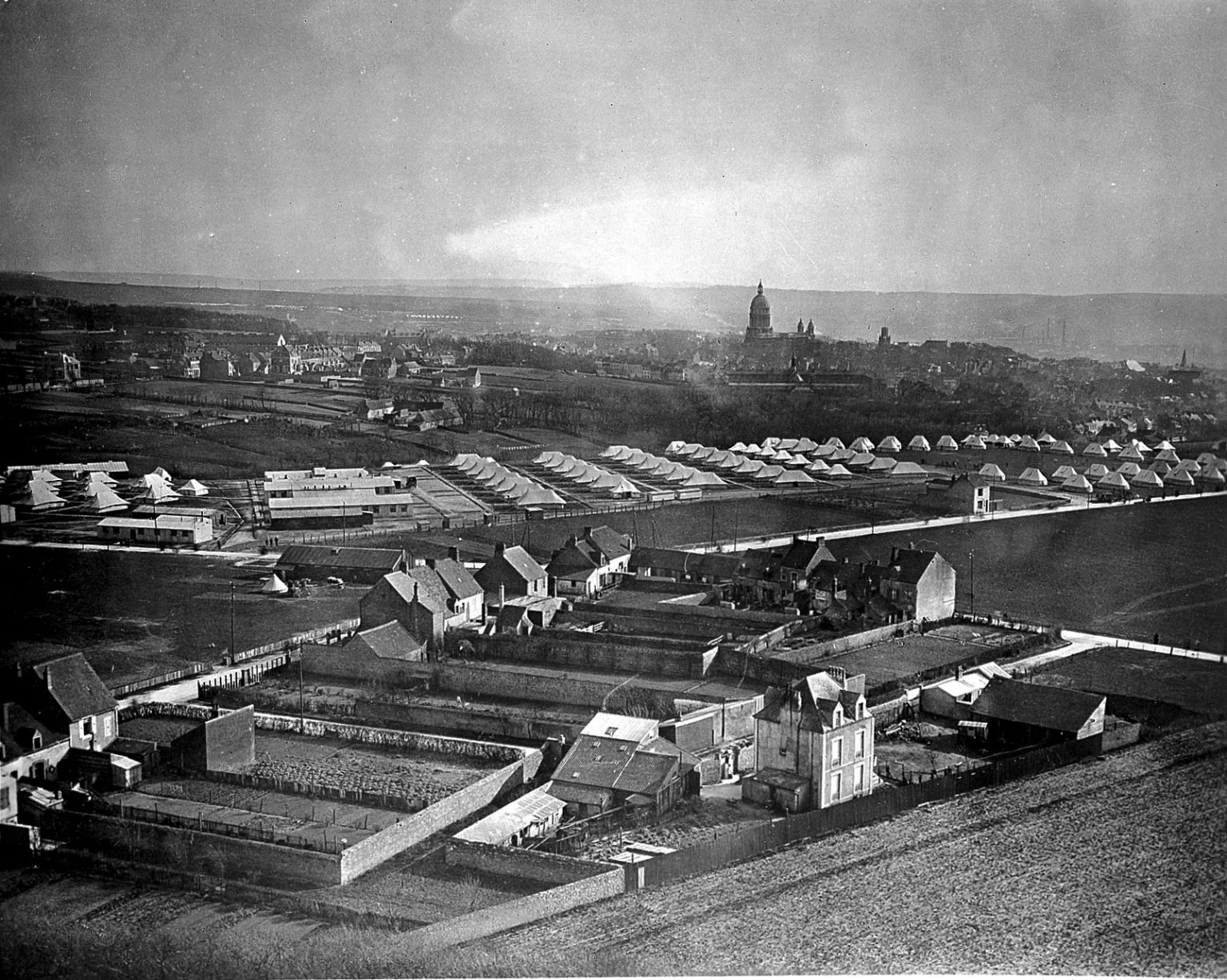 Established at Marlborough Camp, Boulogne on 5 November 1914.
The origins of the name of the camp may relate to the Duke of Marlborough but a crossroads location south-east of the Colonne de la Grande Armée (north of Boulogne) is marked on late 19th Century maps as Malborough and there is today a small housing estate of that spelling nearby.
The image (right) shows Number 1 Convalescent Depot taken from the top of the Colonne de la Grande Armée and shows a convalescent camp. Boulogne centre can be seen beyond. From its location, this can be presumed to be Marlborough Camp and Number 1 Convalescent Depot, later a Demobilisation Depot.
Number 2 Convalescent Depot CD
This Depot was established at Rouen, France on 18 December 1914 and the unit was disbanded on 13 May 1919, when the staff were demobilised and remaining stores handed back to the Army.
Number 3 Convalescent Depot CD
This Depot began to form at Le Tréport on 19 June 1915 and ceased to exist on 14 March 1919.
Number 4 Convalescent Depot
The depot began to form at Parc d’Or, Le Havre on 1 December 1914. The final patients were discharged on 24 March 1919.
Number 5 Convalescent Depot CD
This depot took over a site (5-26 July 1915) at Wimereux formerly used by 8 Stationary Hospital and admitted on 1 August 1915 its first patients. The depot was soon extended into an adjacent site recently evacuated by 1 Canadian Stationary Hospital. By 3 September, the depot was reporting an average of 700 patients treated weekly. And on 25 September the capacity was expanded to enable 1500 patients to be received. Orders were received (28 June 1916) to evacuate to a temporary site at 1 Convalescent Depot and on 7 July orders received to move to a new site “opposite 3 Canadian General Hospital” at Cayeux. On 10 August 1916:38 officers and 777 men of the 1/8th Worcestershire Regiment who had been gassed near Ovillers-la-Boisselle were admitted for 8 days rest. On arrival, they were also found to be verminous and having no change of clothing had to be provided with temporary operation gowns until their regiment could supply replacements. The depot finally closed on 16 March 1919.
Number 6 Convalescent Depot CD
On 11 June 1915, a depot for 1500 patients opened at Etaples, situated very close to 46 (Isolation) Stationary Hospital and 56 General Hospital. The depot closed on 16 May 1919.
Number 7 Convalescent Depot (CD)
The depot site (initially a tented camp) began to form at Dannes-Camiers during June 1915. The depot was declared ready to receive patients on 11 August and the first ten arrived two days later. In November 1915 the site was evacuated by this CD and handed over to be used as 14 and 24 Infantry Base Depots. All stores and equipment were handed in and it appears that this CD temporarily ceased to exist. Sometime during June 1916, this CD reopened at Marlborough Camp, Boulogne. And on 11 January 1919, the depot had been cleared and the site became Marlborough Camp Demobilisation Depot.
Numbers 8 & 9 Convalescent Depots (CD)
These were based in Salonika, Macedonia. Between 1915 and 1918, British troops were part of a multinational Allied force fighting against the Bulgarians and their allies in the Balkans.
Serbia was an ally of Britain and had successfully resisted the attacks of the Austro-Hungarian Army in the opening months of the First World War. But, in October 1915, the combined forces of Austria, Germany and Bulgaria overwhelmed her armies and conquered the country. The Serbs retired through the mountains of Montenegro to Albania, losing over 200,000 men in the winter snow. The survivors were evacuated to the island of Corfu to regroup.
Lack of resources and political indecision among the Allies led to delays in the dispatch of aid to Serbia until it was effectively too late to help. It was eventually agreed to land forces at the vital port of Salonika (now Thessaloniki) in the northern Greek region of Macedonia.
French forces and Lieutenant-General Sir Bryan Mahon’s 10th (Irish) Division, exhausted after service at Gallipoli, began landing at Salonika on 5 October 1915.
In addition to the CD, No. 4 Canadian General Hospital was established in Salonica.
Number 10 Convalescent Depot (CD)
Establishment of the depot site at Écault (8km south of Boulogne) was authorised on 5 April 1917. Construction soon began and on the 7 May 1917, the first patient was admitted. The depot closed on 17 January 1919.
Number 11 Convalescent Depot (CD)
The depot began to be formed on 8 April 1917 at Buchy (28km northeast of Rouen), although construction had long since been started. The site straddled the road from Buchy to Saint-Saëns, near the Montérolier-Buchy railway station. 10 April 1917: The first patient was admitted on 10 April 1917 and the depot was closed on 31 January 1919.
Number 12 Convalescent Depot (CD)
The depot opened on 23 June 1917 on a site at Aubengue (northeast of Wimereux) and received its first 101 patients who had been transferred from 7 CD, even though the construction of the depot was still in progress. The depot closed on 31 May 1919
Number 13 Convalescent Depot (CD)
 The depot opened on 4 August 1917 at a site in Trouville and 999 patients arrived on the day from numbers 1, 7 and 10 CDs. Between 4 August 1917 and 3 February 1919 a total of 66798 soldiers passed through this depot, which to all intents closed on 10 February 1919.
Number 14 Convalescent Depot (CD)
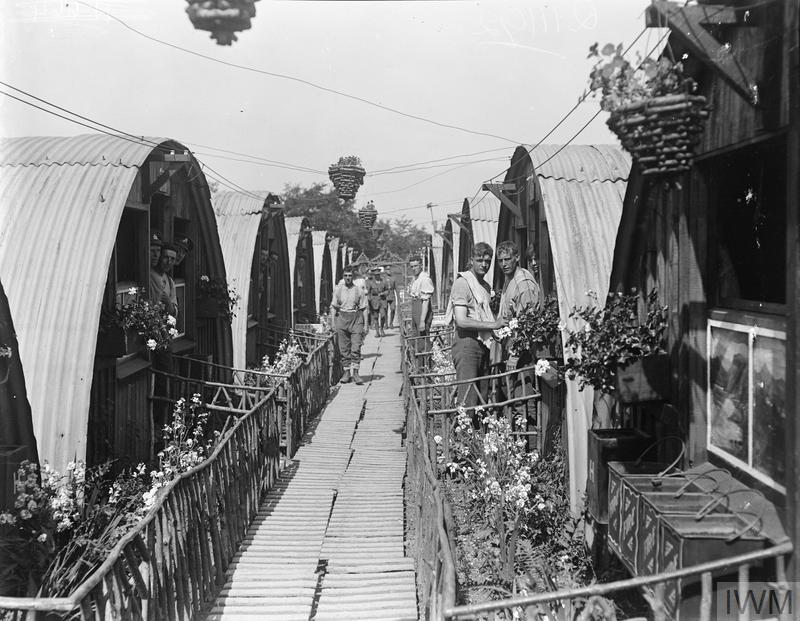
This depot (shown in the image, right) opened on, 30 August 1917, at a site at 5km south of Trouville and the first patients were admitted on 6 September. The depot closed on 31 January 1919 with small numbers of patients still being admitted and discharged.
Number 15 Convalescent Depot (CD)
A number of officers and men arrived from 11 CD on 25 October 1917 to commence operation of this 1000-bed depot, situated at Trouville. However, on 13 November 1918, the depot closed and the site was turned over to become a German prisoner of war camp.
Number 16 Convalescent Depot (CD)
This depot began to form, on 17 January 1918, at Musso Camp, 11km from the port of Marseilles, a site with huts formerly occupied by the British West Indies Regiment and the first patients were admitted on 30 January. The depot was closed on 31 March 1919.
Back to "Blighty"
When a soldier was deemed fit enough for the journey back to England (Blighty as the soldiers called it), they were loaded onto specially adapted trains and taken to French channel ports. Once back in England, they were again loaded onto adapted railway carriages and whole trains were despatched to predetermined locations throughout the country.
The Military carried on caring for their troops until they were either discharged medically unfit, subsequently died from their wounds, were found to be otherwise unfit and transferred to mental hospitals or until they returned to Home Depots for reintegration within the Army and further training. Much of this care took place after the end of WW1. Eventually, the wartime enlarged Army was slimmed down and soldiers were demobbed, usually at the Home Depots.