
Lincoln Edward (Ted) Weiser, Royal Canadian Navy
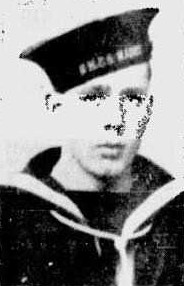 Lincoln Edward (Ted) Weiser was born in Calgary, Alberta, Canada and died when his ship was sunk in the North Atlantic on 22 October 1940. he was just 19 years old and was a very distant relation to my father and therefore, to me.
The actual lineage is as follows:
- Lincoln Edward (Ted) Weiser - 1921-1940 - nephew of the husband of the sister-in-law of a first cousin once removed of the husband of the sister-in-law of the niece of the wife of the brother-in-law of one of my first cousins 3 times removed
- Clara Latetia Hoeh - 1892-1964 - Mother of Lincoln Edward (Ted) Weiser
- Jacob Barnett Hoch - 1868-1954 - Father of Clara Latetia Hoeh
- Lloyd Irving Hoch - 1907-1997 - Son of Jacob Barnett Hoch
- Edith Mae Aiken - 1908-1994 - Wife of Lloyd Irving Hoch
- Samuel Wylie Aiken - 1881-1931 - Father of Edith Mae Aiken
- Glenn Everett Aiken - 1917-1998 - Son of Samuel Wylie Aiken Evelyn
- Dorothy Allen - 1925-2019 - Wife of Glenn Everett Aiken
- Edmund Edward (Ed, Edwin) Allen - 1898-1946 - Father of Evelyn Dorothy Allen
- Walter Allen - 1859-1950 - Father of Edmund Edward (Ed, Edwin) Allen
- Emmanuel Allen - 1833-1908 - Father of Walter Allen
- Ernest Frank Allen Sr - 1877-1948 - Son of Emmanuel Allen
- Arthur Allen - 1909-1989 - Son of Ernest Frank Allen Sr
- Hilda Doeg Jackson - 1911-1989 - Wife of Arthur Allen
- Albert Alfred Jackson - 1877-1942 - Father of Hilda Doeg Jackson
- David Doeg Raymond Jackson - 1909-1978 - Son of Albert Alfred Jackson
- Irene Maud Brookes - 1910-1990 - Wife of David Doeg
- Raymond Jackson Walter Brooke - 1889-1969 - Father of Irene Maud Brookes
- James Brooke - 1845-1925 - Father of Walter Brooke
- Florence Emily Brooke - 1874-1952 - Daughter of James Brooke
- Ernest Henry Harber - 1875-1962 - Husband of Florence Emily Brooke
- Henry Harber - 1847-1931 - Father of Ernest Henry Harber
- John Harber - 1890-1962 - Son of Henry Harber
- Edith Maria (Mary) Hull - 1891-1984 - Wife of John Harber
- Charles William Hull - 1843-1924 - Father of Edith Maria (Mary) Hull
- Thomas Rice Hull - 1801-1858 - Father of Charles William Hull
- George Hull - 1836-1916 - Son of Thomas Rice Hull
- Alice Maria Hull - 1862-1945 - Daughter of George Hull
- Alice Maud Davies - 1887-1948 - Daughter of Alice Maria Hull
- Gilbert Wilfred Hyde - 1916-2006 - Son of Alice Maud Davies
- William G Hyde - Me
His Family
Lincoln Edward (Ted) Weiser was the son of Nicholas Albert Weiser, a farmer who was born in the USA and lived most of his life in Canada.
Nicholas Albert Weiser was born 22 July 1879 in Concord, Morgan, Illinois, USA and was the son of Philip Weiser, born 4 June 1852 in Beardstown, Cass, Illinois, USA who, in turn, was the son of Nicholas Philip Weiser, born 16 July 1820 in Büdesheim, Bitburg-Prum, Rheinland-Pfalz, Germany. All of Nicholas's male relatives were Farmers, so quite naturally he too became a Farmer.
Nicholas Albert Weiser married Clara Latetia Hoeh, born 19 December 1892 in Punxsutawney, Jefferson, Pennsylvania on 19 November 1917 at High River, Alberta, Canada.
Clara Latetia Hoeh was the daughter of Jacob Barnett Hoeh, born 8 April 1868 in Cloe, Jefferson County, Pennsylvania who was, in turn, the son of Johann Jacob Hoch, born 14 February 1841 in Bavaria, Germany.
Although they were married in Canada, Nicholas & Clara set up home & their farm at Christian, Illinois, USA and Nicholas registered with the US Government for war service on 8 0ctober 1918.
Nicholas & Clara raised a family of 4 children:
- An unnamed girl born on 14 Nov 1918 & who died the same day
- Lincoln Edward Weiser - 1921-1940
- Winifred Marie Weiser - 1924-2001
- Frances Pearle Weiser - 1928-1992
After the war, Nicholas, Clara and their family moved back into Canada. Clara died on 31 March 1964 in Haney, Maple Ridge, Vancouver, British Columbia, Canada and Nicholas died on 30 November 1970 in Edmonton, Alberta, Canada. Both are buried Highwood Cemetery, High River, Alberta, Canada.
Lincoln Edward (Ted) Weiser married Ada Jean Stewart in 1938 in Calgary, Alberta, Canada and they set up home on the Weisler property at High River, Macleod, Alberta, Canada and Lincoln continued to work on the family farm.
Ada Jean Stewart was born on 14 February 1921 at Crossfield, Alberta, Canada. Her father, Herbert Turner Stewart (1870-1939) was also a Farmer.
Lincoln & Ada had one child:
Wayne Edward Weiser - 12 Jan 1940 - 24 Apr 1977.
Following Lincoln's death in 1940, Ada remarried James Edward Akins (1911–1970) and the family continued to live & work in Canada.
His Military
Lincoln Edward (Ted) Weiser enlisted in the Royal Canadian Navy at High River, Alberta, Canada on 16 February 1939 - he stated on his enlistment papers that he had previous military experience from being part of the local Militia force and had passed that groups medical.
 The naval dockyard & home port for the Canadian Navy was established in 1911 in Halifax, Nova Scotia, which is where Lincoln would have travelled to, for his training. Lincoln became a Stoker - ensuring the ships fuel oil was delivered at the correct amount, at the correct time to the ship's boilers, upon the orders from the bridge for more or less steam/speed. His work area would have been deep in the bowels of the ship, inside watertight compartments.
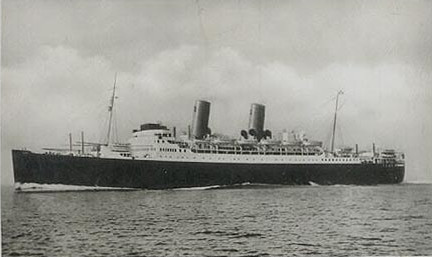
In late July 1940, Lincoln and the soon to be ships company sailed from Montréal, Québec aboard the "Duchess of Richmond" liner belonging to the Canadian Pacific shipping line bound for Liverpool, Lancashire, England. They arrived on the 21 August 1940 and were transported to London to join their new ship, HMCS Margaree H49.
HMCS Margaree H49 was originally commissioned on 21 Dec 1932 as the Royal Navy's HMS Diana.
HMS Diana, a D-class Destroyer was built by Palmers Shipbuilding & Iron Co. Ltd. at Jarrow-on-Tyne, with the hull being laid down on 12 Jun 1931 and the finished ship launched on 16 Jan 1932.
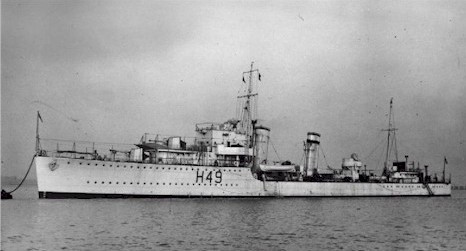 HMS Diana was 329 feet long with a beam of 33 feet and a draught of 12 feet 6 inches.
She was powered by Parsons geared steam turbines, driving two shafts, which developed a total of 36,000 shaft horsepower & gave a maximum speed of 36 knots. Steam for the turbines was provided by three Admiralty 3-drum water-tube boilers. Diana carried a maximum of 481 tonnes of fuel oil that gave her a range of 5,870 nautical miles at 15 knots.
The ship had four 45-calibre 4.7-inch Mark IX guns in single mounts. The anti-aircraft defence was provided by a single 12-pounder AA gun between her funnels and two QF 2-pounder Mk II AA guns mounted on the side of her bridge. She was fitted with two above-water quadruple torpedo tube mounts for 21-inch torpedoes. One depth charge rail and two throwers were fitted nad 35 depth charges were carried.
Normally, the total ship's company consisted of 145 officers and men.
Upon entering Royal Navy service, HMS Diana was initially assigned to the Mediterranean Fleet before she was transferred to the China Station in early 1935. She was temporarily deployed in the Red Sea in late 1935 during the Abyssinia Crisis, before returning to her duty station where she remained until mid-1939. HMS Diana was transferred back to the Mediterranean Fleet just before the Second World War began in September 1939.
On 15 February 1940, HMS Diana escorted HMS Duncan as she was towed by tugs from Invergordon (Scotland) to the Forth for permanent repairs after the latter had been damaged in a collision whilst escorting a convoy.
She also served with the Home Fleet during the Norwegian Campaign (9 Apr 1940 – 10 Jun 1940).
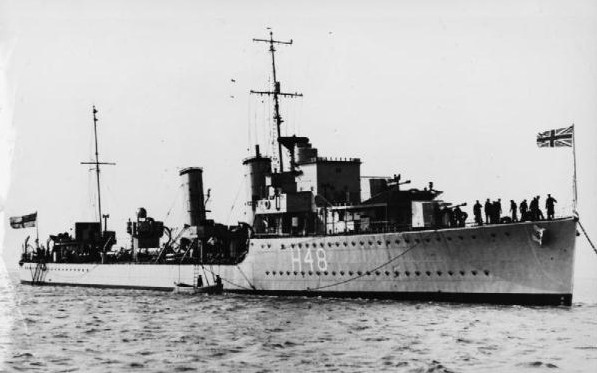 HMS Diana was to be transferred to the Royal Canadian Navy following the sinking of RCN HMCS Fraser (H48), a C class destroyer. The Fraser had also started its life with the Royal Navy as HMS Crescent.
HMS Crescent was built by Vickers Armstrong in Barrow-in-Furness after being ordered on 9 Jul 1930, laid down on 1 Dec 1930 and launched on 29 Sep 1931.
HMS Crescent was transferred to the RCN, renamed HMCS Fraser (H48) & commissioned on 17 Feb 1937
At 10.30 PM on 25 June 1940 HMCS Fraser was given orders to proceed to Bordeaux, France to help in the rescue of an estimated four thousand refugees trapped in the area by the German military forces. Accompanying the Fraser was the Canadian destroyer HMCS Restigouche and the British cruiser HMS Calcutta. In rough seas and poor visibility, the captain of the Fraser decided that the three ships should move closer together and ordered a turn to port in order to bring his ship behind HMS Calcutta. In doing so the two ships collided, the bow of the heavier Calcutta sliced into the side of the Fraser with such force that the lighter vessel was cut into three pieces. Forty-five crew members were killed and nineteen men from the Calcutta lost their lives.
The terrible irony of it all is that when HMS Diana was transferred from the RCN and became HMCS Margaree, many of the survivors of the HMCS Fraser incident were transferred too.
HMCS Margaree was commissioned into the RCN on 6 Sep 1940 (following a refit in London during July 1940) and that is when Lincoln & the rest of the naval party who had travelled from Halifax, Nova Scotia aboard the Duchess of Richmond would have joined the ship, to prepare her for her new role as a convoy escort.
His Death
HMCS Margaree formed up with aa five-ship "fast" Atlantic convoy - OL8 - out of Liverpool bound for Halifax, Nova Scotia on 17 October 1940. Fast convoys travelled at an average sped of 12-13 knots, whilst slow convoys travelled at an average speed of 8 knots (making them a bigger target for the U-Boats & enemy planes). The fast convoys hoped to use their speed and agility (fewer ships per convoy) to avoid running into the enemy.
The OL designation convoys were grouped around at least one ocean liner but often included numerous other Merchant Navy cargo-carrying ships, escorted by a variety of Royal Canadian Navy ships.
Due to German U-Boat attacks, by July 1940 all Atlantic shipping, from Liverpool, had to be routed through the Irish Sea and around the north of Ireland before entering the North Atlantic, resulting in layover stops being made at Northern Ireland ports before the crossing proper was started.
 Convoy OL8 left Londonderry bound for Canada on 20 Oct 1940.
Two days later on 22 October 1940, HMCS Margaree (Cdr. Joseph Wilton Rouer, RCN) was sunk in the North Atlantic while escorting convoy OL-8, in position (approx.) 53º24'N, 22º50'W after a collision with the freighter Port Fairy.
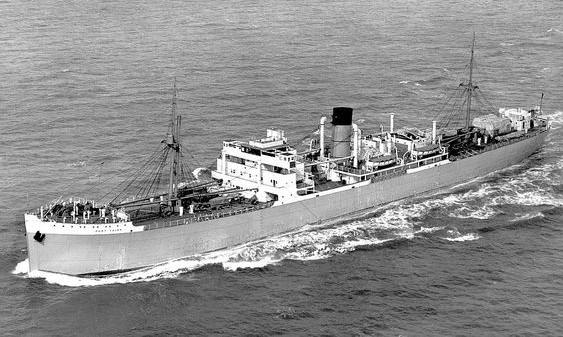
MV Port Fairy was built in 1928 by Swan Hunter for the Commonwealth & Dominion Line Ltd (or "Port Line") shipping company and was named after the Australian port town in south-western Victoria.
MV Port Fairy was built as a refrigerated cargo ship, powered by 2x4 cylinder 2SCSA oil engines to twin screws. In 1930 her refrigeration equipment was modified and she carried the first cargo of chilled meat (instead of frozen meat) from Australia; she later worked the same cargo from New Zealand.
Throughout WW2, MV Port Fairy was employed as an ammunition carrier.
On the 22 October 1940, with visibility reduced by rain, HMCS Margaree cut across MV Port Fairy‘s path, seconds later at 0100 the freighter sliced into HMCS Margaree near the bridge, severing the forward section of the destroyer, which sank immediately. The stern section remained afloat and after removing the survivors to Port Fairy the freighter attempted to sink the Margaree with gunfire. With the hulk on fire and sinking slowly, Port Fairy rejoined the convoy.
Eighty-six of the 142 sailors lost on HMCS Margaree had survived the sinking of HMCS Fraser. One of the 142 was Lincoln Edward (Ted) Weiser.
Two men perished whilst climbing up the side of the rescuing Port Fairy when they fell and were crushed between the ships. The survivors rescued by Port Fairy were returned to Canada by 13 November 1940. Four of the surviving officers became rear admirals or commodores, and the Port Fairy survived the war and was eventually scrapped in Hong Kong in 1965.
The OL8 incident also ended the OL series convoys - they were deemed to be too dangerous and were scrapped after OL8 finally docked in Halifax.
 His Memorial
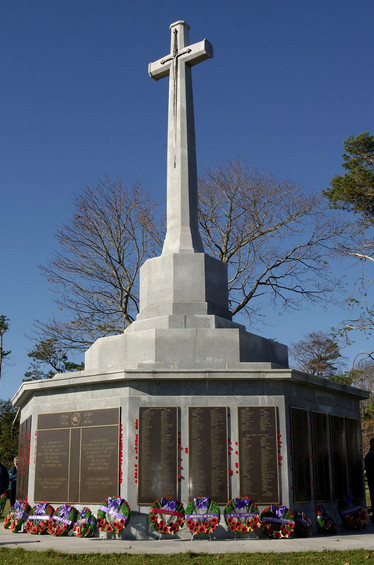
Lincoln Edward (Ted) Weiser along with the other 141 who perished on that fateful night are commemorated on the Halifax Memorial.
The Halifax Memorial was built by the Commonwealth War Graves Commission and the Government of Canada. It commemorates 3,267 Canadian and Newfoundland sailors and soldiers who lost their lives in the First and Second World Wars, and who were formerly commemorated by a memorial standing on Citadel Hill, Halifax.
When it became apparent that the old memorial had deteriorated to the extent that it was unworthy of its purpose of commemorating Canadian war dead, it was demolished. The panels upon which the names of the war dead were inscribed were consigned to the sea with appropriate ceremony of 7 November 1966.
The new memorial consists of a great granite Cross of Sacrifice twelve metres high, similar in design to those in the Commission war cemeteries around the world. The cross is mounted on a large granite podium bearing panels of bronze upon which are inscribed the names of those whose graves are at sea.
Following the First World War, Canada and New Zealand requested that the commemoration of their dead, lost at sea, should be in their respective countries. The original Halifax Memorial was built in 1924 and upon it were inscribed the names of 415 sailors, all but 41 of the Canadian war dead “missing, presumed lost” at sea. The 41 were lost in the Pacific Ocean and their names are inscribed on the Victoria Memorial, Ross Bay Cemetery, Victoria, British Columbia.
After the Second World War, the names of 2,852 Canadian sailors and soldiers lost at sea in that war were added to the Halifax Memorial. A special section was also included for the sailors of the Newfoundland Merchant Navy who between 3 September 1939 and 31 December 1947 went to sea never to return.
Her Majesty’s Canadian Ships and visiting warships when entering or leaving Halifax Harbour and passing the Halifax Memorial between Colours (0800 hours daily) and sunset ‛pipe the still’ to render honours.
The Memorial was erected in Point Pleasant Park. The Park is located on the southern tip of the Halifax peninsula with Halifax harbour to the left.
The inscription found on the memorial:
1914 - 1918
1939 - 1945
IN THE HONOUR OF THE MEN AND WOMEN OF THE NAVY, ARMY AND MERCHANT NAVY OF CANADA WHOSE NAMES ARE INSCRIBED HERE THEIR GRAVES ARE UNKNOWN BUT THEIR MEMORY SHALL ENDURE
Lincoln Edward (Ted) Weiser and the rest of ships company who perished that dark October night are commemorated on Panel Four of the Memorial.